
Let Unified Theory Inc. of Camarillo, CA help you with your next Industrial Process, Mechanical, Structural or Electrical project.
Our team of engineers can handle almost any industrial process system design.
Whether your project is for conveyor controls, emission controls, exhaust systems, air handling systems, fluid systems, materials handling systems or high speed manufacturing, UTI can handle it all.

Engineering Consultants in Southern California

WELCOME TO THE UNIFIED THEORY, INC. (UTI) BLOG


We serve Industrial Clients with Engineering and Architectural Resources, Processing and Facility Needs.


Save Time
Save Money
Access Industry Experts


UTI offers a full range of industrial and commercial architectural services, including project management, construction management and training.
Showing posts with label emission control. Show all posts

Monday, January 21, 2008

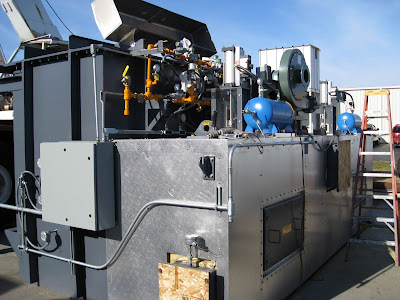
VOC emission control using an Thermal

Regenerative Thermal Oxidizers – RTOs are used to capture and eliminate VOCs from an air stream.


Thermal treatment of VOC's and other air pollutants works by a simple reaction of the harmful air pollutants with oxygen and heat. In this environment the VOC's are converted to CO2, water vapor (H2O), and usable heat. These harmless by-products are released to atmosphere or use an energy recovery technique to further lower the operational costs.

UTI and its personnel have years of VOC's experience and have developed, through years of experience, process strategies and system configurations:

  • Solvent Handling, including VOCs Emission Reductions and Recovery
  • Odor Control through various technologies: Scrubbers, Carbon Adsorption, Bio Technology and Thermal Oxidation
  • Thermal Oxidation Systems ranging in size from 2,000 cfm to 250,000 cfm
  • Solvent Recovery Systems ranging in size from 5,000 cfm to 25,000 cfm
  • Bio Technologies up to 30,000 cfm
  • Incident Investigation of Failed Systems
  • Improved VOC Capture Efficiency for Process Systems
  • Provided the Design and Specification for VOC's Emission Reduction Equipment and Systems
  • Developed Standard CAD Details for VOC's Emission Reduction Systems
  • Redesigned Stack and Source Dampers in Conjunction with VOC's Emissions Reduction Equipment to Improve Process Optimization, Comply with MACT Standards and Reduce Energy Costs
  • Optimized Thermal Oxidation Systems
  • Specified Solvent Recovery Coil Replacements
  • Provided Financial Analysis for VOC's Emission Reduction Systems to Provide the Most Cost Effective System for given Applications
  • Provided Incident Investigation for Misapplied VOC's Emission Reduction Systems and Equipment Failures
  • Provided Expert Witness for Failed VOC's Emission Reduction Systems
  • Provided Solvent Extraction Systems Engineering Design
  • Designed Solvent Handling, Storage and Unloading Facilities
  • Designed Inline Moisture Process Control Systems
  • Developed Pulp & Paper Plant P&ID Drawings for Hazardous Systems
  • Created Process Flow Drawings & Mass Balance Tables
  • Designed Tether (Life Line) Certification
  • Provided Calendaring Roll Design and Consultation
  • Design Overhead Material Handling Systems and Hoist Certification
  • Engineered Polyester Fiber Handling System
  • Created Trim/Weed Conveying System
  • Provided Ammonia Engine Room Redesign and Certification
  • Designed Sewer System Design
  • Construction Management for Chemical Plants, Food Plants and Greenfield Facilities
  • Designed Furnace Gas Train Evaluation and Design
  • Provided Gas Train Design and Specifications
  • Designed and Developed Laminator and Sputter Platform Equipment
  • Provided Engineering for an Automotive Plant Expansion

Monday, January 14, 2008

Sources of VOC Emissions

The paper, film and foil coatings product category listed under section 183(e) of the CAA includes coatings that are applied to paper, film, or foil surfaces in the manufacturing of several major product types for the following industry sectors: pressure sensitive tape and labels (including fabric coated for use in pressure sensitive tapes and labels); photographic film; industrial and decorative laminates; abrasive products (including fabric coated for use in abrasive products) and flexible packaging (including coating of non-woven polymer substrates for use in flexible packaging). The category also includes coatings applied during miscellaneous coating operations for several products including: corrugated and solid fiber boxes; die-cut paper paperboard, and cardboard; converted paper and paperboard not elsewhere classified; folding paperboard boxes, including sanitary boxes; manifold business forms and related products; plastic asceptic packaging; and carbon paper and inked ribbons.

Coating performed on or in-line with any offset lithographic, screen, letterpress, flexographic, rotogravure, or digital printing press is not part of the paper, film and foil coating category. In addition, size presses and on-machine coaters that function as part of an in-line papermaking system are not part of the paper, film, and foil coating category. The application of inks, coatings and adhesives on or in-line with rotogravure or flexographic printing presses used in the production of flexible packaging is addressed in the CTG for Flexible Package Printing (EPA 453/R-06-003, September 2006). The application of inks, coatings and adhesives on or inline with publication rotogravure printing presses is addressed in the CTG for Graphic Arts: Rotogravure and Flexography (EPA 450/2-78-033). The application of inks, coatings and adhesives on or in-line with offset lithographic or letterpress printing presses is addressed in the CTG for Offset Lithographic Printing and Letterpress Printing (EPA 453/R-06-002, September
2006).